What does it mean to be Intelligent?

I am a Ph.D. student exploring Embodied Intelligence. I write about Math, CS, AI and my views on them.
Definition
Any serious study of Artificial Intelligence must begin with definitions. Not because definitions settle debates, but because they expose assumptions. Dictionaries offer a useful but incomplete starting point. The Oxford English Dictionary defines Artificial Intelligence as:
the theory and development of computer systems able to perform tasks that normally require human intelligence.
Merriam Webster defines it as:
a branch of computer science dealing with the simulation of intelligent behavior in computers.
These definitions share two implicit ideas. First, intelligence is identified through tasks. Second, intelligence is framed through comparison with humans. Both assumptions are historically contingent. They reflect how early researchers encountered intelligence. Humans were the only known intelligent systems, so intelligence was defined by imitation.
However, these definitions are insufficient for scientific progress. They are descriptive rather than normative. They do not tell us what intelligence ought to be, nor how to evaluate it formally. To move beyond dictionary meanings, Artificial Intelligence requires a conceptual framework grounded in mathematics, decision theory, and computation.
This tension between informal intuition and formal specification motivates the rest of this chapter.
Thinking versus Acting; Humanly versus Rationally
Russell and Norvig organize definitions of AI along two orthogonal axes. Thinking versus acting, and humanly versus rationally. This classification is not merely pedagogical. It encodes philosophical commitments about mind, behavior, and optimality.
Thinking Humanly
The thinking humanly approach views Artificial Intelligence as the attempt to model human cognition. The goal is not performance, but fidelity. Systems are evaluated by how closely their internal processes resemble those of humans.
This view aligns with cognitive science. It treats the human brain as the reference implementation of intelligence. Experimental psychology, neuroscience, and introspection become sources of data. Models are constrained not only by input output behavior, but by reaction times, memory limits, and error patterns.
Mathematically, this approach is underdetermined. Multiple algorithms can produce identical behavior while relying on radically different internal mechanisms. Moreover, human cognition itself is not optimal. Biases, heuristics, and systematic errors are well documented. Modeling them faithfully may reproduce limitations rather than intelligence.
Acting Humanly
Acting humanly shifts the focus from internal processes to observable behavior. The most famous example is the Turing Test. An agent is intelligent if it behaves indistinguishably from a human conversation.
This approach avoids speculative models of the mind. It defines intelligence operationally. If behavior is correct, the internal method is irrelevant.
Ye this definition inherits all ambiguities of behavioral equivalence. Deception, memorization, and shallow pattern matching can pass restricted tests without understanding. Acting humanly also fails to generalize beyond human capabilities. Humans are not optimal calculators, planners, or controllers.
Thinking Rationally
The thinking rationally approach defines intelligence as correct reasoning. It draws from logic and philosophy. An intelligent system derives correct conclusions from correct premises.
Formally, this view assumes that intelligence can be reduced to inference. Given a knowledge base expressed in logic, the system applies inference rules to derive new knowledge.
The limitation is computational. Logical inference in expressive systems is intractable. Moreover, the real world is uncertain, continuous, and partially observable. Pure logic struggles to represent noise, time, and probability.
Acting Rationally
Acting rationally defines intelligence as taking actions that achieve the best expected outcome given available information. This is the rational agent view.
Here, intelligence is not imitation, nor introspection, nor perfect reasoning. It is performance relative to a goal. The agent selects actions that maximize a utility function under uncertainty.
This definition subsumes the others. Thinking rationally is useful insofar as it improves action. Acting humanly is a special case where human behavior is optimal under a given metric.
This view provides a mathematical foundation for AI and is the organizing principle of this series.

The Rational Agent View
An agent is any entity that perceives its environment through sensors and acts upon that environment through actuators. This definition is deliberately minimal. It includes humans, robots, software processes, and even biological organisms.
Let the environment be denoted by a set of states $S$. At each time step $t$, the agent receives a percept \(p_t\) generated by the environment. The sequence \((p_1, p_2, \ldots, p_t)\) constitutes the percept history.
The agent selects an action \(a_t\) from a set of possible actions $A$. The environment transitions according to some dynamics, possibly stochastic.

The central question is: how should the agent choose its actions?
Rationality
A rational agent is one that does the right thing. More precisely, it selects actions that maximize the expected value of a performance measure given its percept history and built in knowledge.
Formally, let $U$ be a performance measure mapping sequences of states to real numbers. The agent aims to maximize
\[\mathbb{E}\left[ U \mid p_1, \ldots, p_t \right]\]
Rationality is not omniscience. A rational agent is not one that always succeeds, but one that makes the best decision given what it knows and what it can compute.
This distinction is crucial. It separates rationality from perfection.
Performance Measures
Performance measures define what counts as success. They are external to the agent. They encode the designer’s objectives.
For example, a self driving car may be evaluated based on safety, travel time, energy consumption, and passenger comfort. These objectives may conflict. The performance measure must trade them off explicitly.
Poorly designed performance measures lead to pathological behavior. An agent that maximizes speed alone may drive dangerously. Thus, defining intelligence requires defining value.
Task Environments and PEAS
To specify an agent formally, one must define its task environment. Russel and Norvig introduce the PEAS framework: Performance measure, Environment, Actuators, and Sensors.
Consider an automated vacuum cleaner.
Performance measure may include cleanliness, energy efficiency, and time. The environment is a room with dirt and obstacles. Actuators include motors and suction. Sensors include bump sensors and dirt detectors.

The PEAS description abstracts away implementation details. It focuses on the interaction between agent and world.
Properties of Task Environments
Task environments can be classified along several dimensions. These classifications determine algorithmic choices.
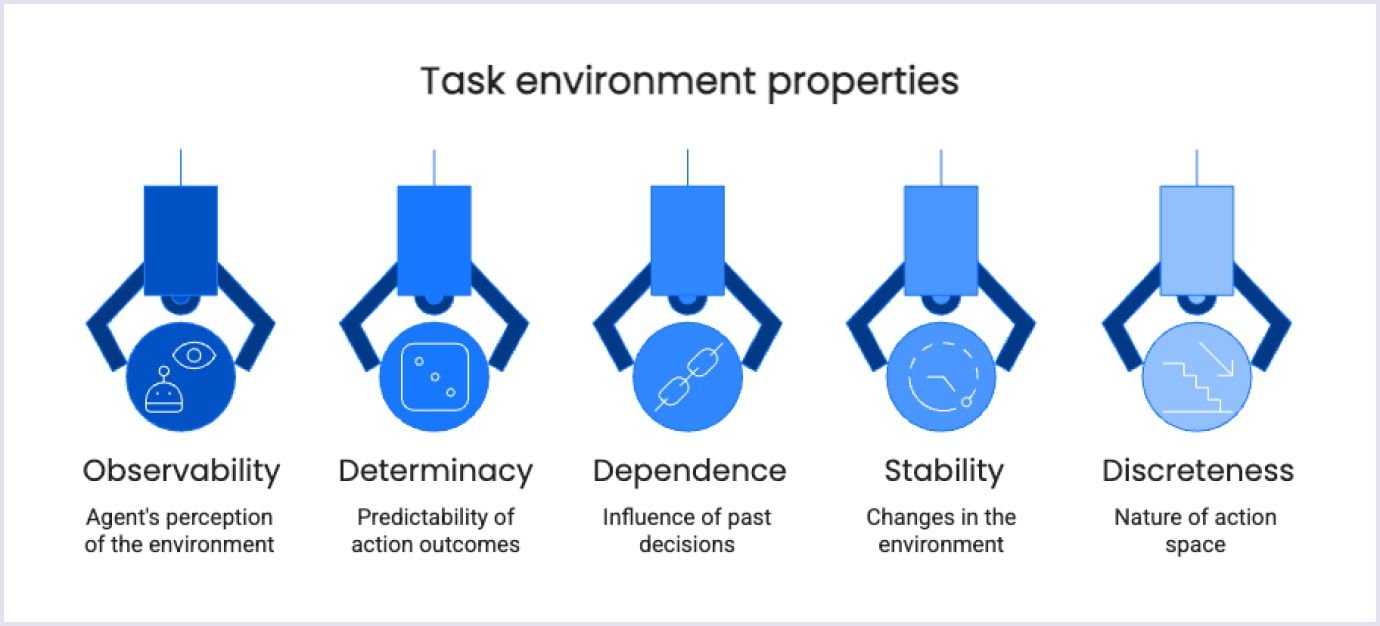
Fully-Observable vs Partially Observable
In a fully observable environment, the agent’s sensors provide complete information about the state. Chess is an example.
In partially observable environments, sensor data are noisy or incomplete. Most real world problems fall into this category.
Deterministic vs Stochastic
A deterministic environment has predictable outcomes. Stochastic environments involve randomness.
Uncertainty requires probabilistic reasoning. Determinism allows planning via search.
Episodic vs Sequential
In episodic environments, each decision is independent. Image classification is episodic.
In sequential environments, current actions affect future states. Control and planning problems are sequential.
Static vs Dynamic
Static environments do not change while the agent deliberates. Dynamic environments do.
Time pressure changes the nature of rationality.
Discrete vs Continuous
Discrete environments have finite states and actions. Continuous environments require differential equations and approximation.

Agent Functions and Programs
An agent function maps percept histories to actions.
\[f: P^* \to A\]
This function is a mathematical abstraction. An agent program is its implementation on a physical architecture.
Different programs may implement the same agent function with varying efficiency.
Types of Agents
Russel and Norvig classify agents by increasing sophistication.
Simple Reflex Agents
These agents act based solely on the current percept. They implement condition action rules.
They fail in partially observable environments because they lack memory.

Model-based Reflex Agents
These agents maintain an internal state representing aspects of the world not directly observable. They update this state based on percepts and actions.
This introduces a rudimentary form of memory and belief.

Goal-based Agents
Goal-based agents select actions to achieve explicit goals. They reason about future consequences.
Planning and search algorithms arise naturally here.

Utility-based Agents
When multiple goals or tradeoffs exist, utility functions provide a quantitative criterion.
Utility-based agents maximize expected utility, unifying decision-making under uncertainty.

Learning Agents
Learning agents improve performance over time. They consist of a performance element, learning element, critic, and problem generator.
Learning does not replace rationality. It supports it by improving models and policies.

Autonomy and Learning
An agent is autonomous if it relies on its own experience rather than built-in knowledge. Complete autonomy is neither achievable nor desirable. All agents encode prior assumptions.
Learning allows agents to adapt to unknown environments. However, learning without structure is inefficient. Inductive bias is necessary.
Philosophical Perspective
The rational agent view aligns with a consequentialist philosophy. Actions are judged by outcomes, not intentions. This raises ethical and epistemological questions.
Who defines the utility function? How are long-term consequences weighted? Can all values be quantified?
These are not engineering details. They are foundational questions that shape system behavior.
Why Intelligent Agents Matter Today?
Modern AI systems are often described in terms of models rather than agents. Yet at deployment, every system becomes an agent. It perceives inputs, acts on the world, and produces consequences.
Large language models generate text that influences decisions. Control systems drive physical machines. Recommendation systems shape behavior.
Understanding these systems as rational agents clarifies their limitations and responsibilities.
Closing Reflection
This blog established the conceptual foundation of Artificial Intelligence as the study of rational agents. We moved from informal dictionary definitions to a formal framework grounded in perception, action, utility, and uncertainty. By distinguishing between thinking and acting, and between human likeness and rational optimality, we arrived at a definition of intelligence that is both mathematically precise and practically relevant.
Intelligent behavior is not about replicating the human mind. It is about making good decisions under constraints. Agents, environments, performance measures, and rationality form the minimal vocabulary for this endeavor.
As we proceed in this series, every algorithm, model, and system will be evaluated through this lens. Artificial Intelligence is not a collection of techniques. It is a theory of action in the world.


